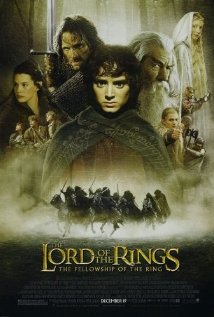
J. R. R. Tolkien’s The Lord of the Rings trilogy is an epic fantasy that has steadily accrued a large and committed following since its release in the 1950s. Criticism of the books, however, has persisted with equal fervour. Together, the praise and criticism serve to demonstrate the impact of Tolkien’s work on the public and critical world alike. The reasons for the success of the novels can be found in their ability to transport the reader into a Secondary World; one which contains its own set of rules, moral order, and an ‘inner consistency of reality.’ In The Lord of the Rings, and his earlier work The Hobbit, Tolkien creates a landscape which is both convincing and strange. Through encountering the familiar and the unfamiliar, the adult reader reflects upon his or her own Primary World, and perceives it in a new light. This is ultimately where the relevance of Tolkien’s fantasy lies. Of course, not everyone is able to connect with Tolkien’s world; indeed, to those who view Middle-earth as a poor reflection of our own society, the books are destined to remain irrelevant. This attitude, however, need not reflect any inability on Tolkien’s part to produce conditions in which disbelief is (in)voluntarily suspended. To the many who do find significance in Tolkien’s world, the tales of Middle-earth will continue to inspire a new perspective on life and reality.
In The Hobbit, Tolkien introduces his readers to Bilbo Baggins, a hobbit closely bound to the earth, who lives a content and virtually untroubled life. The novel takes places in a time where ‘there was less noise and more green.’ Bilbo is (arguably) very similar to a middle class Englishman, who delights in food, drink, smoking, company, and peace and quiet. The homely depiction of Hobbiton, while it does not possess the complexities of real life, is at least familiar enough to secure the reader’s interest and increase the veracity of the tale. The Shire, in which Hobbiton is located, represents an ideal rural life encroached upon by the destructive forces of industrialisation. It represents a yearning for a simpler and natural life. As Bilbo is whisked away into the mysterious world that lies beyond the Shire, so the reader is wrenched from his or her comfort zone into the fantastic world Tolkien has created. The reader, along with Bilbo, meets dwarves, Beorn (a skin changer who could take the form of a bear or Man), dragons, goblins and various other strange creatures. We see ourselves in Bilbo, and thus experience and marvel at all his adventures with a similar fascination. The Hobbit, however, is not an ordinary fairy tale. Bilbo returns to his home without enjoying the spoils of victory, maturing into a more responsible and morally aware hobbit. Moreover, echoing Tolkien’s cynicism of the modern world, the end of novel is marked by darker themes of profit and revenge.
Some critics find the narrative tone of The Hobbit patronising and intrusive: ‘It was just at this moment that Bilbo suddenly discovered the weak point in his plan. Most likely you saw it some time ago, and have been laughing at him; but I don’t suppose you would have done half as well yourselves in his place.’ When the narrator directs comments to the reader, reminding him or her of their own Primary World, the spell of the Secondary World is broken. Tolkien himself confesses to employing a patronising narrative tone in The Hobbit. Ultimately, the novel is not as successful as The Lord of the Rings in transporting the reader wholly into another world, and lacks the latter’s complex characterisation. As Paul H. Kocher has argued, ‘Gandalf is merely a funny old wizard…And in a mistaken attempt to please an audience of children Tolkien trivialises and ridicules his elves and dwarves in precisely the manner he later comes to deplore.’ Furthermore, the geography and setting of The Hobbit tends to be rudimentary, possessing little of the breadth we later see in The Lord of the Rings. Although the novel witnesses moments of moral ambiguity, the lines of good and evil are clearly drawn. But in fairness, Tolkien did not set out to create an epic fantasy in The Hobbit; it was a tale clearly meant for children. Nonetheless, by the novel’s end, we have certainly gone ‘there and back again’; but, like Bilbo, we have returned with an altered view of life.
Frodo, likewise, is a courageous and humble hero. The reader is able to relate to Frodo because he does not possess archetypal Heroic qualities such as god-like powers and limitless confidence in his abilities. Realistically, Frodo begins his task with reluctance: ‘I wish it need not have happened in my time.’ But he persists with unwavering commitment. Withstanding the burden of carrying the Ring, Frodo exerts his utmost effort to resist its powers. As a result, the task was completed. The morality of Frodo’s quest is thus an inspiring one: with courage and faith, any person, irrespective of physical stature, can affect the course of history. After the arduousness of his journey, however, Frodo is ready to face death if only to relieve the burden of his memories. He sacrificed a part of himself for the sake of Middle-earth – a part intrinsic to his soul: ‘But I have been too deeply hurt’, Frodo explains to Sam. ‘[S]ome one has to give them up’, he continues, ‘lose them, so that others may keep them.’ It is in sailing into the West that Frodo hopes to find some peace. Frodo is not the only one who experiences loss: the Elves, losing the power of their three rings, must also leave Middle-earth: ‘Yet if you succeed, then our power is diminished, and Lothlórien will fade, and the tides of Time will sweep it away. We must depart into the West…’ Nothing remains certain at the end of the tale: evil does not disappear, and the characters do not live “happily ever after.” Indeed there is no certainty that triumph will be final. But the deeds of the Fellowship remain as a testament to the possibility of defeating evil in one’s own lifetime.
In order to further demonstrate how Tolkien was able to create a convincing and relevant Secondary World, an exploration of his thoughts on fairy stories and their function in society is essential. In his essay ‘On Fairy-Stories’, Tolkien admits to real forces working within and about the fairy-story: ‘behind the fantasy real wills and powers exist, independent of the minds and purposes of men.’ It is therefore a self-contained ‘reality.’ He describes the realm of fairy-story as being filled with ‘shoreless seas and stars uncounted; beauty that is an enchantment, and an ever-present peril; both joy and sorrow as sharp as swords.’ Adopting this wide array of feelings and states, Tolkien’s work becomes not only realistic, but highly appealing. It encompasses many human emotions as antithetical as joy and sorrow, and in doing so reduces the risk of alienating its readers. Tolkien’s world resonates with adults because it is not a complete myth. It is not an idealised world containing a clear division between right and wrong. Moreover, the characters of The Lord of the Rings are not simply placed in a good versus evil framework. Gollum is a prime example of one tortured by his own desires and addictions, seemingly capable of redeeming himself until the very last moment when he is overcome by evil. Representing the duality of man, he is constantly plagued by conflicting sentiments. Corruption is also prevalent in the world of men; men who are enchanted by power and the possibilities it offers. Denethor, Steward of Gondor, cares little for the creatures of Middle-earth outside the bounds of Gondor. Conversely, Frodo, Sam, Merry and Pippin build and maintain friendships with Rohan and Gondor. The hobbits take relief in knowing they have aided the lives of many outside, as well as inside, their beloved Shire. Their compassion, therefore, is not limited to one place or people. Realism is thus achieved not only through familiar settings, but through the diversity of the characters that inhabit them.
Middle-earth has its own self-contained geography, maps, mythology, history, songs, as well as comprehensive languages. The reader comes across many familiar entities in this world, such as suns, moons, trees, and other wonders of nature. But they are illuminated and invested with greater significance. Upon seeing the mystical quality of Lothlórien, Frodo began to see his surroundings as ‘fresh and poignant, as if he had at that moment first perceived them and made for them names anew and wonderful.’ ‘The history of fairy-stories’, Tolkien comments, ‘is probably more complex than the physical history of the human race, and as complex as the history of the human language.’ Tolkien brings a truthful air to his work by creating a world with a history and moral order as complex as our own. The lines between myth and history are blurred and indeed melded. We even see in Tolkien’s world reverberations of our own history. Humans’ tendency for nostalgia prompted Tolkien to illuminate things of antiquity, which have ‘an appeal in itself.’ We might ask whether Tolkien runs the risk of alienating his readers by depicting a world so distant in time and landscape. I would argue that it is a risk worth taking: distance allows the reader to yearn for something long forgotten, yet not completely irrecoverable. Our passions and desires are in effect revived by immersing our imaginations in a myth-like world.
Tolkien appears to have achieved the feat of creating rapport with a wide variety of readers. Paying homage to his Secondary World, many students in the past donned the badge ‘Frodo Lives’. Frodo ‘lives’ because people refuse to see him and Middle-earth cast into oblivion. In order for fantasy to reach such levels of success, contends Tolkien, the Secondary World must possess inner control mechanisms, which prevent it from degenerating into delusion and hallucination. Inside the Secondary World, therefore, ‘what he relates is ‘true’: it accords with the laws of that world. You therefore believe it, while you are, as it were, inside.’ The laws of nature and of morality in Tolkien’s Middle-earth mirror those of the Primary World. Gauging the relevance of such moral overtones is, however, a process conditioned by one’s own cultural and social presuppositions. In addition, Tolkien observes that fantasy allows the reader to recover and escape, not from life, but from the triviality of it. Fantasy, therefore, acts as an antidote to life’s mundane moments. Joy, that ‘eucatastrophic’ feeling, ‘in successful Fantasy can thus be explained as a sudden glimpse of the underlying reality or truth.’ Both joy and sorrow characterise the ending of The Lord of the Rings: we feel Sam’s sorrow as Frodo leaves Middle-earth in search of respite, but we rejoice with him as he invests the Shire with new life.
The Lord of the Rings mirrors the repetitiveness of the Primary World, in which evil manifests itself in new forms: ‘Always after a defeat and a respite, the Shadow takes another shape and grows again.’ Time is therefore cyclical, not linear. There is also realism in recognising that the forces of evil are strong, and that good is not always more powerful. Not even Gandalf declares full confidence in his powers: ‘I am Gandalf, Gandalf the White, but Black is mightier still.’ Furthermore, the ends and means are not as simple as some critics would imply. Should they use the Ring in order to defeat Sauron? This is eventually rejected on the basis that the Ring cannot be wielded, not even by powerful and wise Elves: ‘as long as it is in the world it will be a danger even to the Wise…I fear to take the Ring to hide it. I will not take the Ring to wield it.’ Neither does Aragorn, a descendant of the High Kings and ancient Númenorean race, risk taking the Ring into his keeping. The Fellowship agrees to do all it can to keep the forces of Sauron at bay; to uproot ‘the evil in the fields that we know, so that those who live after may have clean earth to till.’ In achieving this task, the Fellowship comes to rely on the assistance of the hobbits: small hands do them ‘because they must, while the eyes of the great are elsewhere.’ Indeed the battle before the gates of Mordor is but a diversion from the main progress of the small heroes. The hobbits demonstrate that the power and influence of evil may be limited by faith and sacrifice. Despite (or perhaps because of) their size, they become capable of determining a part of history’s course.
Dreamland, W. H. Auden asserts, has no definite time or place, which occurs at the cost of ‘aggravating the tendency of the genre to divorce itself from social and historical reality.’ In contrast, The Lord of the Rings has its own framework of time and place, and although distant, does not divorce itself from our reality. We begin to look upon the past with greater reverence; to a golden age that can yet be reborn. The moral and natural laws of Middle-earth appear consistent and inviolable, and for the most part are not in contradiction with our laws. The unfamiliar in Tolkien’s world, however, holds our attention just as much as the familiar. It plants within the reader renewed wonder and aspiration. Ultimately, fantasy constructs a bridge between the natural and supernatural world (the Primary world and Secondary World), and Tolkien’s heroes act as mediators between the two.
Criticisms of Tolkien’s work tend to revolve around claims of Tolkien’s irrelevance in the modern world. Philip Toynbee wrote in 1961 that ‘these books were dull, ill-written, whimsical and childish.’ This, however, seems more a reflection of Toynbee’s aversion to the fantasy genre itself than a serious assessment of Tolkien’s work. According to Patricia Meyer Spacks, a ‘critic who demands verbal complexity, integrity, richness, subtlety, will find little to attract him in Tolkien’s fiction.’ However, the richness of the landscape and history, the ambiguity of the ‘good characters’, and the subtlety of evil’s workings all combine to make The Lord of the Rings worthy of critical attention. Spacks is not alone in craving for more ‘adult’ themes: Edmund Wilson, undermining his critical position by the sheer generality of his attack, argues that fans of the book ‘have a lifelong appetite for juvenile trash.’ Such criticisms do little in the way of explaining the popularity of Tolkien’s books. Also unwilling to regard fantasy as significant literature, Kenneth McLeish argues that ‘the cult that has mushroomed round [Tolkien’s] imagined world is as dottily devoted, and ultimately as frivolous (because remote from reality) as those endless genealogies of invented races and grammars of made-up languages that stuffed Tolkien’s own mind and plump up even his minor work.’ Moreover, according to McLeish, ‘the vision of society put forward in The Lord of the Rings is old-fashioned, wrong-headed and a lethal model for late twentieth-century living…to put it bluntly, we live in a nasty, dangerous and brutal world, and dressing up in elven-cloaks, baking lembas and writing poems in Entish…is a way of avoiding, not finding, the truth of life.’ McLeish has evidently misconstrued the aims of Tolkien’s fantasy. It is not an allegory of moral perfection; moreover, Tolkien does not purport to teach people how to live a ‘true’ life. Furthermore, contrary to what McLeish would have us believe, fans of The Lord of the Rings do not all dress up in Elven cloaks. The majority are in fact readers who appreciate The Lord of the Rings for its imaginative scope, historical richness, geographical significance, and enchanting inhabitants. McLeish’s distaste for Tolkien’s work should therefore not translate into an attack on those who find meaning where he could not.
In both Tolkien’s The Lord of the Rings trilogy and The Hobbit the reader is taken from a familiar setting and thrust in a secondary world that is both old and new. His or her subsequent viewpoint rests largely with the hobbits as they traverse the wide and strange, and yet familiar lands of Middle-earth. Both elements of the strange and familiar prove crucial in attracting and sustaining the reader’s attention. Many objects in the Primary World become cast in a different light, revealing them, to Tolkien at least, in their truer form. While not all may find Tolkien’s world appealing or significant, its long standing popularity remains testament to the books’ power and influence. Middle-earth resonates, reaffirms and redefines our desires and our world. It challenges our perceptions and shakes us out of dull complacency. Through convincing settings and characterisations, The Lord of the Rings becomes a reflection of our world, and thus proves itself an exemplary model of successful fantasy.

 I’ve been lucky enough to be introduced to the poetry of Lucille Clifton (thanks, Caits!) and want to share it with you, too. I love her compact, evocative and passionate style. Beautiful, bold, and concise.




 Raidah Shah Idil, MG Author